
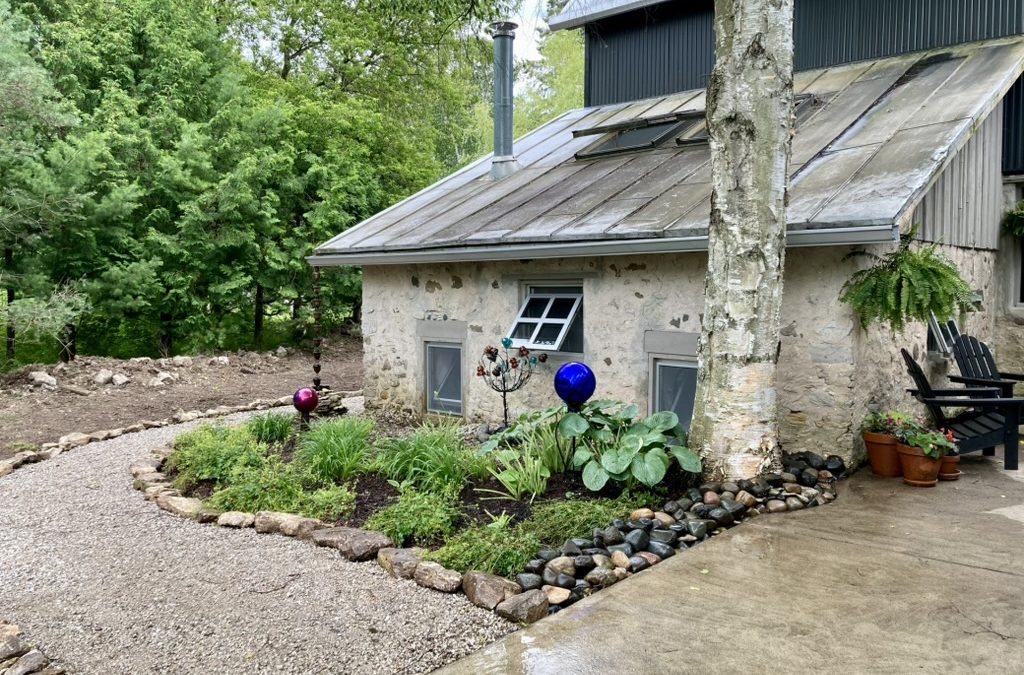
Some places do more than shelter us. They change the quality of our attention, broaden what we can imagine, and make room for the next chapter of our lives to come into view. Research in environmental psychology suggests that physical environments shape not only how well people think but also what they think about, with natural settings supporting restoration, a broader perspective, and reflection on life’s larger questions.
That insight helps explain why certain places remain with us for decades. A summer camp, a shoreline, a retreat center, a cabin in the woods, an old barn on a peninsula — these places often become part of our developmental story because they provide enough distance from ordinary life to enable a different kind of seeing. Research on camp has found links between high-quality camp experiences and growth in identity, social skills, spirituality, responsibility, presence, and connection to nature.
For many people, those early memories of camp become a template for what a formative place feels like. Michael Eisner’s account of Camp Keewaydin presents camp not as a backdrop but as a life-shaping environment whose lessons in leadership, resilience, and character carry into adulthood. What camp often gives children and adolescents is not simply recreation but a bounded world in which they can try on new roles, build confidence, and return home with a subtly changed sense of self.
Place and the mind
One of the most compelling strands of recent research is the finding that the environment shapes thought content. Studies comparing time in nature-rich settings with time in commercial indoor settings found that natural places were associated with more positive thought, less self-focused rumination, and more reflection on spirituality and life journey. Attention Restoration Theory offers one explanation: natural environments engage “soft fascination,” allowing overworked directed attention to rest and recover.
This helps explain why a walk near water, along a forest path, or through a quiet field can feel mentally clarifying in a way a conference room rarely does. Walking itself also matters. Stanford research found that walking significantly increased creative output, especially the divergent thinking needed to generate new possibilities and fresh connections.
The Japanese practice of shinrin-yoku, or forest bathing, extends this insight. Reviews of the research indicate that time spent in forest environments can reduce stress, improve mood, and support attention and physiological recovery. Whether in a Japanese cedar forest or on a Door County peninsula, the deeper principle remains: some places help the mind breathe.
Place, retreat, and inner spaciousness
Dan Harris’s Meditation for Fidgety Skeptics adds an important inner dimension to this conversation. Harris argues that the goal of meditation is not to eliminate thought but to change one’s relationship to it through repeated moments of noticing and beginning again. His stories about silent retreats underscore how a quiet container can make the habitual voice in the head newly visible, not to defeat it, but to meet it with more awareness and less fear.
Journalist Dan Harris recounts going on a silent meditation retreat and discovering, often uncomfortably, how loud and insistent the voice in his head really was. What changed his life was not escaping that voice, but learning to see it more clearly and relate to it with a little less fear and a little more curiosity. In Meditation for Fidgety Skeptics, he argues that meditation is simply training for this new relationship with our thoughts, no incense required. In a way, that is exactly what retreats in places like Door County are designed to support: the outer quiet and beauty give us space to finally hear ourselves think, and simple practices of awareness help us notice which thoughts we want to build a life around and which ones we are finally ready to release.
That is one reason retreat matters. The right place provides outer spaciousness, while contemplative attention cultivates inner spaciousness. Together, they make discernment possible. Retreat research similarly suggests that restorative settings can support the integration of past and present, reprioritization, and a greater capacity to move forward with intention.
For those in the third period of life, this combination may be especially important. The questions of this season — what still matters, what is mine to do now, what might I create, and how might I contribute — rarely yield to constant busyness. They need space.
A barn on the peninsula
That conviction came alive in a memorable way at Hesly Center during a retreat for a transportation company’s leadership team. Over a couple of days, they worked intensively in the barn’s conference room, nicknamed the Lyceum, shaping the vision and strategy for the next phase of the company’s growth. During the retreat, they were encouraged to step away from the work, get outside, and perhaps walk down to Kangaroo Lake.
One afternoon, after such a walk, the team returned across the grounds laughing and talking with an ease that had clearly not been there when they set out. Then one person began doing cartwheels across the lawn, soon joined by another. In that moment, the research seemed visible in human form: the shift from strain to spaciousness, from guarded professionalism to play, and from effortful problem-solving to possibility.
That evening, the barn held them differently again. There was dinner, music, conversation, and a pool table in full use, with sounds coming from the lofts and the sound of a team settling into something more like community. On the final day, a vintage truck converted into a wood-fired pizza oven arrived, and custom pizzas served on the patio at the entrance to the barn marked the close of the retreat. One of the leaders pulled me aside and invited me, along with the hosts, to surprise the team by wearing the team’s new sweatshirts featuring the gathering’s theme: Breakthrough.
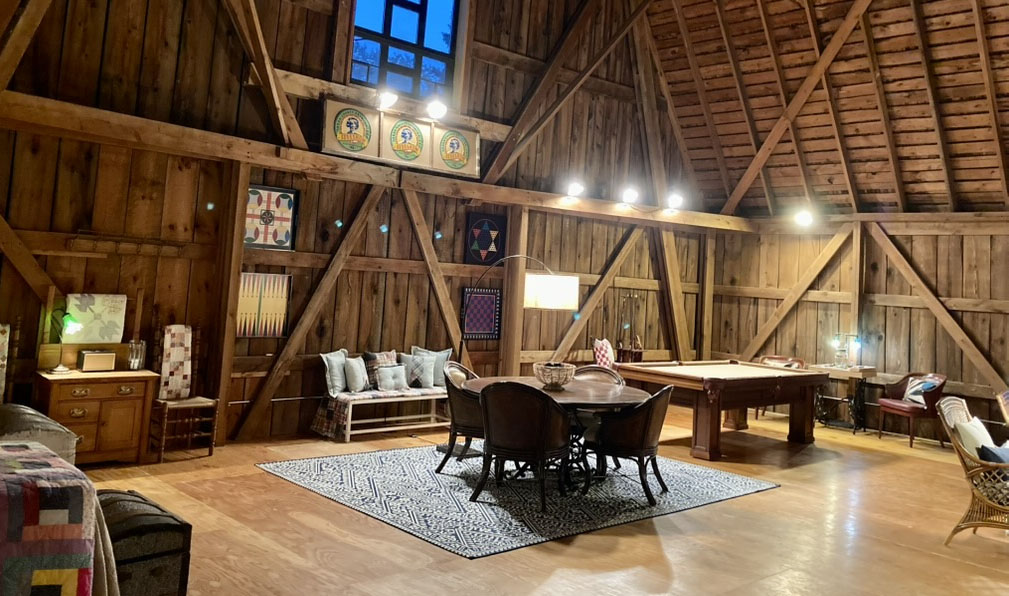
That word captured what the barn and the land around it had made possible. Appreciative Inquiry names four movements — Discover, Dream, Design, Deliver — and the retreat embodied all four. The place itself had become part of the work: not just a venue but a partner in helping a team imagine and inhabit a larger future.
Camp, calling, and the third period
Seen through a wider lens, this is not so different from what camp once did for children or what certain family retreats have done for parents standing at thresholds in work and life. Camp research suggests that high-quality camp experiences can foster independence, responsibility, belonging, empathy, presence, and an affinity for nature, and that alumni often remember camp as a place where important parts of who they became first took shape.
The same developmental logic can apply later in life. Adults also need places where the usual scripts loosen, where new roles can be tried on, and where reflection can lead to decision. A restored dairy barn in Door County may not be a summer camp, but it can serve a similar function: a bounded, restorative, possibility-rich environment where people discover, discern, and design what comes next.
Questions for reflection
If place has more power than many of us realize, it is worth asking where that power has already been at work in our lives.
- What places from childhood, adolescence, or adulthood still live in your memory because something important in you came alive there?
- Where do you reliably feel more spacious, more grounded, or more able to imagine your life from a larger vantage point?
- What settings tend to narrow you into urgency, performance, or survival mode?
- Which environments invite the best version of you and your thinking — strategic, creative, contemplative, relational, or spiritual?
- Where have you experienced the kind of ease, play, or laughter that signals a deeper exhale?
- What place has functioned as a threshold for you — a camp, a retreat center, a shoreline, a porch, a cabin, a trail, a sanctuary?
- If the next chapter of your life needs a different environment, what might that environment be?
- What might become visible if you gave yourself more regular access to places where space becomes possible?
Insight prompts
These prompts can help translate reflection into discernment.
- A place that has shaped me more than I realized is…
- When I am in that kind of environment, I notice that I think more about…
- The role that environment plays in my flourishing is…
- One place that consistently restores my attention is…
- One place that helps me hear my deeper life questions is…
- The difference between where I am productive and where I am generative is…
- The next season of my life may require more time in places that are…
- A small experiment I could run to test the power of place in my own life is…
Possible actions
Insight becomes wisdom only when it’s lived. The invitation is to run a few small experiments with how you use place to see, in real time, how different surroundings change your attention, perspective, and choices.
- Make a place inventory. List five places that have left you feeling more alive, peaceful, creative, or clear. Notice the qualities they share.
- Schedule a thinking walk. Once this week, take a 20- to 40-minute walk in a natural setting without earbuds, purely to notice what your mind does when you move.
- Create a mini-retreat. Block half a day in a restorative place — a lake, park, porch, chapel, or cabin — and go there with one real question about your next chapter.
- Pair place with practice. In that setting, sit quietly for five minutes and simply notice thoughts arising and passing, borrowing Harris’s skeptic-friendly approach to awareness rather than striving for perfection.
- Return to a formative place. If you can, revisit a camp, retreat center, or other place that once shaped you; if you cannot go physically, write about it in detail and notice what it stirs now.
- Design spaciousness into gatherings. If you lead others, build in a walk, a shared meal, or unstructured time in a meaningful setting rather than treating those moments as optional extras.
- Name your threshold place. Identify one place you want to use more intentionally in this season as a setting for discovery, discernment, and design.
- Share the experiment. Ask a spouse, friend, sibling, or colleague, “Where do you go when you need to hear yourself think?” Then compare what you notice.
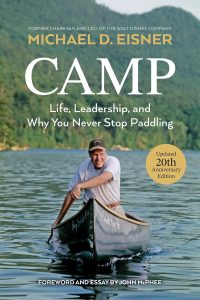
Camp: Life, Leadership, and Why You Never Stop Paddling
Michael D. Eisner
A memoir of the summers he spent at Camp Keewaydin in Vermont and the way that particular place shaped his character, relationships, and leadership over a lifetime. He describes camp as a contained world where kids learned resilience, teamwork, and responsibility by paddling canoes, sleeping under the stars, and navigating real-world challenges together, long before they had titles or careers. Looking back from later life, Eisner credits that formative environment with giving him a durable compass for decisions made decades later in boardrooms and studios. For readers in the third period of life, his story is a reminder that certain places leave a long developmental echo and that it is never too late to return to, or intentionally seek out, geographies that help us live into the leaders, parents, and elders we are still becoming.

Meditation for Fidgety Skeptics
Dan Harris, Jeff Warren, and Carlye Adler
A practical, often funny guide to building a realistic mindfulness practice, especially for people who are skeptical, restless, or convinced they “cannot meditate.” Harris’s stories of silent retreat and everyday practice show how a few minutes of simple awareness can change one’s relationship to the voice in the head, making a person less yanked around by fear, habit, and reactivity. It is a strong companion for anyone using camps, barns, shorelines, or retreat settings as places for deeper discernment in the third period of life.
Some places do not simply host our lives; they help us revise them. The invitation is to pay attention to those places, return to them more deliberately, and allow both place and spaciousness to do their work.
References
American Camp Association. (2023). National Camp Impact Study: Final report. https://www.acacamps.org/research/camp-research
Bialeschki, M. D., Henderson, K. A., & James, P. A. (2007). Camp experiences and developmental outcomes for youth. Child and Adolescent Psychiatric Clinics of North America, 16(4), 769–788.
Eisner, M. D. (2005). Camp. Warner Books.
Eisner, M. D. (2025). Camp: Life, leadership, and why you never stop paddling (20th anniversary ed.). Harper Business.
Hansen, M. M., Jones, R., & Tocchini, K. (2017). Shinrin-yoku (forest bathing) and nature therapy: A state-of-the-art review. International Journal of Environmental Research and Public Health, 14(8), Article 851. https://doi.org/10.3390/ijerph14080851
Harris, D., Warren, J., & Adler, C. (2017). Meditation for fidgety skeptics: A 10% happier how-to book. Spiegel & Grau.
Henderson, K. A., Thurber, C., Whitaker, L. S., Bialeschki, M. D., & Scanlin, M. M. (2007). Youth development and the camp experience. New Directions for Youth Development, 2007(115), 75–87.
Kaplan, R., & Kaplan, S. (1989). The experience of nature: A psychological perspective. Cambridge University Press.
Kardan, O. (2022). How the physical environment influences thought content: The role of naturalness and visual features [Doctoral dissertation, University of Chicago]. University of Chicago Knowledge Repository. https://knowledge.uchicago.edu/record/4021
Ohly, H., White, M. P., Wheeler, B. W., Bethel, A., Ukoumunne, O. C., & Garside, R. (2016). Attention restoration theory: A systematic review of the attention restoration potential of exposure to natural environments. Journal of Toxicology and Environmental Health, Part B, 19(7), 305–343. https://doi.org/10.1080/10937404.2016.1196155
Oppezzo, M., & Schwartz, D. L. (2014). Give your ideas some legs: The positive effect of walking on creative thinking. Journal of Experimental Psychology: Learning, Memory, and Cognition, 40(4), 1142–1152. https://doi.org/10.1037/a0036577
Wright, F. T. (2018). Essays exploring the restorative potential, experiences and outcomes of Christian retreats [Doctoral dissertation, Bond University]. Bond University Research Repository. https://research.bond.edu.au/en/publications/essays-exploring-the-restorative-potential-experiences-and-outcom